Emy

Emy
always happy

Tuesday, April 12, 2011

The Last Man Goes With The Last Tree


30 years ago when Kojo Adu was growing up at Nsemere in the Wenchi Municipality of the Brong Ahafo Region, there were giant trees everywhere.

Kojo loved the green tall trees and the fresh air and has fond memories of the area. He used to run around as well as take long walk near the forest on his way to the family’s farm.

Today, the story is different, considerable portions of the once-extensive forests have been destroyed.

Large portions of the natural vegetation have been destroyed due to the clearing of land for agriculture and construction of houses.

Data at the Forestry commission show that there are 20 forest reserves covering a total of area of 233,469 hectors in the Brong Ahafo, however the activities of illegal timer operators, which have been on the rise in recent times, have left the conserved areas with damaged trees.

It is not only in the Brong Ahafo that forest is lost every year since forest in every part of Ghana has been decreasing rapidly and significantly.

Large tracts of forest have been cleared for the cultivation of cash crops such as cocoa, Jetropha, which thrive in the rich soil of the rain forest while bulldozers of rich mining companies are cutting down trees to make way for their operations.

In the Northern part of the country, deforestation, overgrazing and periodic drought have led to desertification and soil erosion.

There has been rampant encroachment of our forest reserves in recent times due to the production of timber for export and the local market as well.

Kwabena A. Otu-Danquah, Chief of the Renewable Energy Division of the Energy Commission is worried about the indiscriminate felling of trees for charcoal and firewood which has become a very lucrative business.

It is difficult to regulate the industry and put a stop to the practice because charcoal happens to be the major source of energy for cooking in most Ghanaian homes,.

He said his outfit discovered that large volumes of charcoal were being exported out of the country under the non–traditional export and “we decided that if we allow people to export without permit the country will become a desert in the not-too-distance future.”

Ghana’s rate of forest depletion has hit 62,000 hectares annually and the country’s forest is currently regarded as one of the highest degraded in the developing world.

The poor rating is because the country’s total forest cover of 8.2 million hectares during the 20th century has been reduced to about one million presently.

The lost of forest is presenting a major challenge to policy makers and environmentalists, who are proposing various forms of measures to redeem the situation.

To address the alarming level of degradation and depletion of the country’s forests, government has decided to strictly enforce policies and associated legislation on forestry to ensure the sustainability of natural resource and bio-diversity conservation in the country.

Government in February this year launched the National Plantation Development Programme as part of efforts to reduce the rate of deforestation and significantly bringing down its effects on rural communities.

So far about 10,000 hectares of forest plantation have been attained out of the targeted 51,000 hectares of forest projected to be planted by end of 2011.

According to Afari Dartey, Chief Executive Officer (CEO) of the Forestry Commission, degraded forest reserves and off-reserve areas will be replanted to achieve a sustainable resource base that will satisfy future demands for industrial timber and enhance environmental quality.

The programme had so far created 40,000 jobs in districts across the country in the areas of seedling production, land clearance, planting and other tending activities.

Collins Dauda, Minister of Forestry, Lands and Natural Resources, believes the forestry sector is receiving attention in recent times, both in terms of its relevance and contribution to resolving national problems and the large quantum of resources being poured into it to achieve the desired goals.

Ghana has ratified international agreements protecting tropical forests, wetlands, and the ozone layer and this has led to the banning of the export of raw logs.

Hon. Dauda maintained that efforts were also underway to restructure the timber processing sector to achieve increased value-addition before exports.

Experts have said that the world’s ability to control climate change could be crippled if global leaders do not support clear and effective targets to address deforestation.

At the United Nations Climate Change Negotiations in Cancun, Mexico, this December proposals have come up for key agreements on a global strategy to reduce emissions as a result of deforestation and forest degradation, known as REDD+.

Government negotiators meeting in Cancun are considering several proposals to tackle climate change, including the emissions caused by deforestation and forest degradation, which account for 15 percent of total global greenhouse gas emissions.

Gerald Steindlegger, Policy Director of World Wildlife Fund, said reaching an agreement on REDD+ is critical to saving forests, preserving biodiversity, and benefitting people.

This is because an estimated 60 million indigenous people worldwide depend on forests for their livelihoods, and forest resources directly support the livelihood of 90 percent of the 1.2 billion people who are extremely poverty,
“But because a few critical issues are unresolved, there’s a real risk that governments could end up with a REDD+ deal that doesn’t benefit people or the planet. The world’s governments need to ensure they get REDD+ right,” he said.

REDD+ aims to reduce emissions by having developed countries pay developing countries not to destroy their forests.

Trees act as one of the largest storage for carbon on earth and helps to reduce emissions.

Benefits of forest cover is enormous because aside helping to curb climate changes; it reduces the rate of water runoff as well as protects soil erosion.

Because trees transpire large quantity of water and shade to the soil, their destruction often leads to a hotter and dryer climate.

The forest also serves as an avenue for recreational activities and tourist attraction, which go a long way to pump money into the economy of the country.

Removal of trees causes rapid runoff and flooding, which makes oil erosion more rampant.

The constant harvesting of trees along streams and rivers drastically reduces the fish as increased exposure of water bodies to sunlight may negatively affect the fish.

Friday, November 26, 2010

Saving Ghana’s Textile Industry


The textile lane behind the TUC building at the City Business centre is specifically dedicated to African prints and the traders are always trying to attract pedestrians to patronize their wares.

The textiles come in a variety of colures, designs and texture. About 150 million yards of African prints worth $250m are sold in Ghana each year.

The shop of Ama Amoah, a trader is filled with assorted textiles including Real Super Wax, Block Print, Super Real Wax, Imitation Wax, Java and Fancy prints embossed with the labels of known textile companies in the country.

Unsuspecting buyers are lured by the cheap prices of these textiles but they do not know that they are buying stuffs that threaten their lives.

Last week, a task force, made up of officials of the Ministry of Trade and Industry, Customs, Excise and Preventive Service (CEPS), Ghana Standards Board (GSB) and Ghana Police Service destroyed Three-hundred-and-ninety-one full pieces of pirated textiles, worth GH¢200 million which were seized from warehouses and opened markets,.

The pieces of cloth, which were burnt to ashes at the Kpong landfill site, were substandard goods smuggled into the country.

They were pirated textiles with fake patent or registered logos of local manufacturing companies such as the Akosombo Textiles Limited (ATL), Ghana Textiles Print (GTP) and Printex which had copied labels of the GS B.

The decision to destroy the pirated fabric was initiated by a taskforce set up by the Ministry of Trade and Industry to curb the importation of pirated Ghanaian textiles.

Before destroying the heap of the textiles which were said to have been imported from China, Anthony Doku, Director of the Research, Planning and Monitoring Department of the Ministry of Trade and Industry, told journalists that the destruction was in line with World Trade Organisation (WTO) regulations.

Under the WTO rule, when goods infringe intellectual property rights, trademark, trade name and patent among others, governments are expected to adopt certain special measures to address the issues.

Governments, according to the WTO, should not allow the re-exportation of contraband goods but rather destroy or dispose them off.

The issue of pirating has been identified as a major challenge to the global economy. Governments around the world have used punitive measures to deter both existing and prospective traders from exploiting works that have been done by people through hard work.

“It is incumbent on government to show commitment to protecting and promoting industries and enterprises.

The nation stands to lose a lot if no action is taken,” said Mr Doku.

Prince Arthur, Head of Destination Inspection at the Ghana Standard Boards, explained that examination of the fabrics indicated that they were produced with substandard chemicals.

“They contain the 28 banned chemicals not allowed for the manufacture of textiles such as the CI acid red, CI basic red, CI direct Blue and many others. These chemicals can cause cancer and some skin diseases,” he explained.

Appiah Donyina, chairman of the taskforce, stated that he was convinced that the destruction of such textiles would deter importers from engaging in the business.

He was worried that none of the importers who engaged in the nefarious activities had so far been punished, noting that “They always run away when we track them down.”

On the other hand, Baffour Asare, Chief Collector Preventive, CEPS, explained that in many cases, it was only the drivers of vehicles who transported the pirated fabrics that were arrested and charged for carrying contraband.

In 2005, the then Minister of Trade and Industry, Alan Kyerematen directed that the entry point for all imports of the African prints should be restricted to the Takoradi Port so it could be easy to track the nefarious activities of smugglers who bring in these pirated textiles.

He also directed that the imported African prints, should be subjected to 100 percent physical examination by CEPS and GSB at all entry points.

Industry players welcomed the directive, but unfortunately these directives were ignored and the illicit activities persist to the detriment of the national economy, textile industries and the employees, the union emphasized.

Abraham Koomson, General Secretary of the Textile, Garment and Leather Employers Union, said the drastic decline in operations of the three remaining textile companies would collapse the entire sector.

“When the smugglers are arrested, prosecution becomes a problem and even the products are not destroyed. In Cote d’Ivoire, all the products and their truck vehicles are destroyed.”

Smuggling has escalated in recent times.

Perpetrators have adopted innovative criminal strategies to overwhelm the police.

The once vibrant textile sector of Ghana with textile companies such as Ghana Textiles Manufacturing Company and Tema Textile Limited used to employ 25,000 workers in the 1970s but cheap imports from China which sell at GH¢8, as against local products which sell between GH¢20 and GH¢30 have collapsed the sector.

Sales in the country have declined by between 50% and 75%, as customers buy Chinese copies of locally produced designs.

Mr Koomsoon strongly contended that seized materials should not be sold or auctioned in any way in Ghana, noting that once that was done, it would legitimize the illegal trade.

To him, the flooding of the country with cheap textiles and the high cost of production could force the companies to shut down.

Latter in an interview, distressed John Kwesi Amoah, Assistant Marketing Manager in charge of brand protection at the Akosombo Textiles Limited, a local manufacturing textile company, stated among other things that the importers of the pirated textiles do not only evade taxes on imported textile prints but do not provide adequate labeling information on country of origin.

He noted that based on the price and texture of the print, buyers could distinguish between the substandard and the genuine textiles since the former is cheaper and usually hard while the latter is soft and a little costly.

The wide disparity in the product pricing is due to low energy cost and interest rates as against high cost of raw materials and high interest rates in Ghana. Nevertheless, the Chinese products lack quality and fade quickly.

Since the burning of the pirated fabrics, stakeholders in the local textile industry and well-meaning Ghanaians have appealed to the Minister of Trade and Industry to sustain the exercise and enforce existing laws without delay.

They believe that the nation is on the right track to stopping to the activities of nation-wreckers.

By Emelia Ennin Abbey

Tuesday, November 23, 2010

So Much Rain, Less To Drink


The Western region is the hub of Ghana’s mining and agric sectors. Tourism is also booming in the area.

Covering an area of approximately 21,391 square kilometres, which is about 10 per cent of Ghana’s total land mass, the region has about 75 per cent of its vegetation within the high forest zone of Ghana
It lies in the equatorial climatic zone that is characterized by moderate temperatures.

The Western region records an average rainfall of 1,600mm per annum. With its lush green hills and fertile soil, farmers in the region provide enough food to feed many Ghanaians.

Cocoa, coffee, rubber among others are mostly grown in the region.

Many small and large-scale gold mines are located in the region. Cape Three Points, which is now prominent on the world map as a result of the recent oil find, is located in the region.

Tourist visit the various parts of the region to catch a glimpse of imposing Portuguese, Dutch, British, and Brandenburgian forts along the coast, which was built in 1512 at the popular village of Nzulezo entirely on stilts and platforms on water.

The first President of Ghana, Dr. Kwame Nkrumah was born at Nkroful in the Western region, which records the highest rainfall in Ghana, but it can not boast of adequate drinking water for its people.

The Ankobra River, Bia River, Pra River in the east and the Tano River on the western national border are unable to solve the perennial water shortage in the region.

Vida Ackah, a 49-year-old woman, lives at Nkroful in her two-bedroom, which according to her, belongs to a maternal aunt with her nine children and elderly husband.

Victoria is faced with the challenge of securing enough water for drinking, cooking, bathing, among others on a daily basis.

She gets up at dawn with her nine-year-old boy to fetch water at the stream or community well.

“During the dry seasons our problems worsen since we walk for long hours in search of water. We return home very exhausted but just the two pans of water is not enough and so we have to try and go about four or five times.”

It is a known fact that the region has had water supply problems for some time now as a result of seawater seepage into its underground water supply, among others.

Water is a basic human necessity that cannot be ignored in this populous area, and the regional office of the Community Water and Sanitation Agency with support from the European Union is adopting various strategies to find lasting solution.

The Small Water and Sanitation Project, the Community Water and Sanitation Agency with support from the European Union (EU), is supporting 20 communities in the Western region.

The project, estimated to cost GH¢43 million, is being replicated in the Central region where 20 communities are being assisted to ensure access to water and improved sanitary conditions in the country’s rural areas.
The project seeks to provide technical support to district assemblies.

It would also encourage communities to construct their own environmental facilities.

A visit to some selected communities in the Central and Western regions revealed that the project was gradually impacting the lives of the people.

There were elevated tanks of varying capacities in all the communities as well as pumps, water treatment plants and standing taps.

Vida, who was about to offer water to visitors, says she now fetches the pipe-born water for drinking and uses water from the river for washing and bathing.

At Adum Banso, Agnes Nsiah, the water board chairperson expressed joy, noting, “This project has rely been beneficial to women and children and it has made life a little easy for us.”

Since the inception of the project, which has led to the construction of 10 pipes in the community, there has been a tremendous reduction in the prevalence of water related diseases
Though getting people to switch from drinking water from traditional river Efuma to hand dug wells in their homes has been difficult, Mrs. Nsaih is confident that “it’s a matter of time.”

People living in Nkroful and Ellembelle are laying pipes to their homes for personal use instead of sharing the community standpipe where an 80-liter bucket goes for Gh5p.

Private water connection to houses and institutions, according to Bismarck Saibi Mensah, an engineer at the Community Water and Sanitation Agency in the Western region is catching on with some people in the communities.

Since the water in the communities has a concentration of salt, the water becomes hard, which makes it impossible to ladder.

The Engineers explained that the water treatment plants have been provided to address the situation.

Abrefa Mensah, Regional Extension Services Specialist of the Western Regional Community Water and Sanitation Agency, implementers of the project, said before the commencement of the project rural potable water supply coverage in the Western region was estimated at 26 per cent.

According to a survey at the end of December 2009, it was discovered that the region’s potable water supply coverage had increased to an estimated 44.20 per cent.

It is however estimated that the on-going projects would increase potable water supply coverage by 12.50 per cent by the end of the year.

Though this would lead to total regional water coverage of 56.70 per cent, Mr Mensah says it is still below the United Nations required 76 per cent under the Millennium Development Goals (MDGs).

However, some regions such as the Upper West, where there is less amount of rainfall through out the year, has the highest water coverage with about 76.34 per cent followed by the Ashanti region (72.14 percent) and Volta (62.63 per cent).

In the Northern region, the water coverage is 60.11 per cent, Greater Accra (59.20 per cent), Upper East (59.19 per cent), Eastern (58.56 per cent), Brong Ahafo (53.61 per cent) and Central (45.10 per cent).

Data available indicates that from 40 per cent in 2000, the national coverage figure rose sharply to 51.7 per cent in 2004 and gradually inched up to the current level of 58.97 per cent at the end of 2009.

Wednesday, August 25, 2010

At The Mercy Of the Flood


Imagine walking for days in a desert without water and food with your throat dry and lips virtually cracking while there appears to be no hope of your immediate need in sight.

All anyone in such a situation would long for in the first place will obviously be water to quench their thirst then if possible wish for food.

Studies indicate that one-third of the African population does not have access to drinking water and almost half of the people on the continent have health problems due to the lack of clean drinking water.

Though 75 per cent of the Planet Earth is covered with water which is why it is also referred to as the blue planet.

Humans need water for a variety of things. Aside drinking, cooking, bathing and washing, other activities such as travel, commerce and entertainment also call for the use of water.

To achieve the United Nations Millennium Development Goals by 2015, aimed at reducing the world population suffering from water shortage by half, the African continent alone, needs at least $12 billion each year to realize this goal.

On the part of Ghana, 78 per cent of the population needs to gain access to potable water before it could attain the MDGs which have a little over five years to reach its target year.

Noble Laureate Mikhail Gorbachev, a former president of the then Soviet Union, once said that “Water, like religion and ideology, has the power to move millions of people.

Since the very birth of human civilization, people have moved to settle close to it. People move when there is too little of it.

People move when there is too much of it. People journey down it. People write, sing and dance about it. People fight over it. And all people everywhere and everyday need it.”

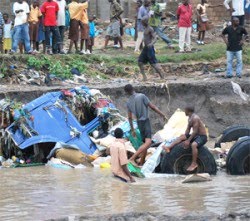
Many in Ghana can not but agree with the noble laureate as after several months of drought, the rains have finally arrived with force, destroying homes, taking lives and leaving crops underwater with over 2000 people feared displaced.

Heavy rainfall in different parts of the country has destroyed lots of property and claimed many human lives.

On Sunday, June 20, Accra, Tema, Sewdru, and some parts of the Western and Central Regions and other towns were hit by a severe downpour of rain.

After over 12 hours of incessant downpour on that day, not only has property been destroyed as about 34 lives have been lost while others are still recuperating in various hospitals across the country.

The rainfall has been described by the Meteorological Services Agency as one of the highest in the country’s history.

Meanwhile, Highways and Roads Minister Joe Gidisu who called the situation a “national crisis” said “never in the last 15 years have we seen this kind of flooding, especially in the Greater Accra Region where roads have been washed away and bridges collapsed, leading to the loss of lives and properties."

Even after four days, Dorothy Danso, a teacher at Kasoa, in the Central Region cannot come to terms with the effects of the torrential rainfall.

Her house has been washed away and a sobering Dorothy looks on helplessly at the debris which is all she has left of her life time investment.

“When can I put up a house of my own again? Why did I have to lose my house as a result of the negligence of the Assembly officials who have not heard our call on them to speed up the construction of drains here?” questioned a tearful Dorothy.

Sections of the Swedru-Winneba road, a major asphalted road that links the two municipalities, were totally destroyed by the floods.

The forceful gashing floodwater destroyed a bridge which cart commuters from both sides while economic activities came to a standstill.

Flooding in Ghana is a perennial problem as each year; the adverse effects of rainfall are felt.

However, over the years, very little has been done to avert the situation.

The coming of the rains and its subsequent flood have left the Metropolitan Assembly officials emboldened to carry out a demolition exercise as it has previously cited buildings on waterways as the main cause of the problem.

Every year, the Metropolitan, Municipal and District Assemblies threaten to demolish buildings on water courses. However, they lack the political will to do so.

Following the recent destruction by rainfall, the National Coordinator of the National Disaster Management Organization (NADMO) has been battling with how to help victims rebuild their lives.

The organization in collaboration with some humanitarian agencies is distributing relief items including food and clothing to victims of the flood.

The military and Red Cross were seen continuing with rescue and evacuation operations in Tema, Ashaima and Kpone, East Accra regions, where over 1,000 buildings were damaged, causing losses to thousands of people.

With other alternative homes being provided for the homeless, the Navy also provided two boats to help ferry people to safety.

According to Ebenezer Dosu, Deputy NADMO Co-ordinator, 200 of the flood victims were provided with alternative accommodation in Swedru, Tema and some parts of Accra.

City authorities are resolute to pursue their decision to pull down all houses in water ways and the Tema Municipal Assembly Public Relations Officer, Frank Asante, confirms that more houses would be demolished as most of the marked buildings “are impediments to the free flow of water.”

Gilbert Boamah, a legal practitioner in Accra obviously supports the authorities as he comments “If we need to clear houses to make it possible for the passage of water during rainfall, we need to do so.”

But it is not all who support the decision. Moses Dartey a resident of Sakomono where a number of houses have been marked with the TMA red paint “to be demolished,” blames the city authorities for failing to monitor and prevent the illegal structures.

To him demolishing the buildings may create new problems and proposes that the water is diverted while proper measures are instituted to prevent the construction of new buildings in water ways.

Those who are likely to be affected by such demolitions demand that they are paid compensations, enough for them to re-settle.

Though many of the houses are in places zoned as flood areas and water courses, some residents claim they were granted building permits by Metropolitan, Municipal and District Assemblies, which the authorities say are fake.

But Major (Rtd) Mensah, PRO of NADMO believes there is no need for such compensations since such buildings are not supposed to be sited there in the first place.

“If it is an illegality, then the state cannot be burdened with providing alternative accommodation or land for affected persons.”

The mayor of Accra, Alfred Vanderpuye, says “we cannot allow such impunity to continue.” He insists only individuals who have permits will be compensated, but those without permits will not.

President John Evans Atta Mills who has since visited the affected victims reminded the affected residents that government would not hesitate to demolish structures on waterways, the effect of which puts a larger responsibility on government.

The phenomena had been blamed on the disposal of solid waste in drains as the choked nature of drainage systems are the causes of the floods. Others have proposed the construction of large underground drains.

Though the country is yet to recover from the havoc caused by the floods, forecasts from the Meteorological Services Agency suggest that Ghana will be recording some more torrential rainfalls.

A walk through most parts of the country with the glaring disaster caused by the rain makes anyone hear the old rhythm that kids learn on their fist day at the Kindergarten: rain, rain go away. Go and come another day, little children want to play. Rain, rain, go away.

It is during these times that Kofi Portuphy, NADMO Coordinator, has come under attack after stating that the organization needs about 68 million euro to help it function more effectively. The amount is to acquire equipment that would help “respond more swiftly and properly to disaster.”

Dr. Nii Moi Thompson who openly expressed contrary view to that of the NADMO coordinator’s is rather of the view that government needs to ensure proper and effective planning to avoid the perennial flooding that confronts the nation.

Monday, August 23, 2010

Daily Guide Picks 3 Awards


Two journalists and the famous crack cartoonist, Akosua of DAILY GUIDE and BUSINESS GUIDE picked three awards at the 15th Ghana Journalists’ Association (GJA) Awards last Saturday night.

This was an improvement over last year’s awards when the leading private newspaper in the country and number two on the sales market picked one award for Best Design and Layout newspaper.

The journalists, Emelia Ennin and Esther Awuah, who received a plaque each and citations for being the best journalists in Environment and Small and Micro Scale Enterprises respectively, were among the 33 persons who were honoured at the awards night.

Akosua, the unsurpassed satirist cartoonist, picked the newly instituted award for cartoons, sponsored by the renowned industrialist Akenten Appiah-Menka of Apino soap fame.
In addition, each award winner will receive a laptop computer.

A reporter from Metropolitan Television, Samuel Agyemang, defied all odds to become the youngest journalist ever to win the coveted Journalist of the of the Year award for 2009.

For his prize, Mr. Agyemang, 29, received a professional enhancement package of $28,000 equivalent to GH¢42, 000 from Unilever Ghana Limited, as well as a visit to the International Centre for Journalists (ICFJ) in Washington DC in the United States, to have attachments at some renowned media houses, depending on his area of specialty.

It was all excitement at the Banquet Hall of State House in Accra, as the GJA celebrated its 15th awards night under the theme: “Unethical journalism and corruption in the media: A danger to democracy.”

Journalists who thronged the venue had the opportunity to celebrate the night with Vice President John Dramani Mahama, Aidan White of the International Federation of Journalists (IFJ) and a host of other dignitaries. They were treated to sumptuous music by Abrantie Amakye Dede and his Apollo High Kings band.

In all, 33 awards were given to journalists and some media houses, while five individuals who have contributed in the flourishing of the media landscape including Mr. Aidan White, were given honorary awards.

The award winners are; for News Reporting, TV – Portia Solomon (TV3); News Reporting, Print – Francis Tuffour (Ghanaian Times); News Reporting, Radio – Evans Mensah (Joy FM); Features, Radio - Kingsley Obeng Kyere (GBC); Features, TV – Samuel Agyemang (Metro TV); Features, Print – Doreen Allotey (Daily Graphic); and Investigative Reporting - Peter Dela Tenge (Metro TV).

Others were, Sports Reporting – Maurice Quansah – (Daily Graphic); Arts, Entertainment and Domestic Tourism - Kofi Akpabli – Freelance; Photo Journalism – Gabriel Ahiabor (Daily Graphic); Business, Finance and Economic Reporting – Edward Nyarko (GTV); Small and Micro Scale Enterprises, Health Reporting – Lucy Adoma Yeboah – (Daily Graphic); HIV/AIDS Reporting – Gertrude Anka – (Ghanaian Observer); Development Journalism for advancing MDGs - Portia Solomon - (TV3); and Rural Reporting – Samuel Akapule – (GNA).

The rest were; Crime and Court Reporting – Kingsley Hope - (Ghanaian Times); Hygiene and Sanitation – Dzifa Azumah (GNA); Disability Reporting – Issah Shaibu – (GBC); Telecommunications – Samuel Dowuona (GNA); Anti-Corruption – Anas Aremeyaw Anas (New Crusading Guide); Education - Isabella Owusu-Oppong – (GTV); Columnist of the Year – Vicky Wirekoh Andoh – (Daily Graphic); Cartoonist – Akosua – (Daily Guide); Best Layout and Design newspaper – (Daily Graphic); Best Rural Radio Station – (Radio Peace -Winneba); Human Rights - Sunrise Radio (Koforidua); Democracy and Peace – (Citi FM); Best Radio Programme in Akan – Wo haw ne sen? (Peace FM); Best Radio Programme in Dagbani – (Diamond FM, Tamale); and Best Radio Programme (Talk) - Kusum Gboo Obonu FM.

Vice President Mahama, who stood in for President John Evans Atta Mills as the guest of honour, commended the GJA for recognizing that there are still unethical practices and corruption in the media.

“The fact that the GJA has chosen this theme means that the media is willing to be accountable to the people with whom the ultimate power rests,” he said.

He cited misreporting, poor language, mercenary journalism and lack of objectivity as some of the challenges that the media needs to overcome and added that there is the need for journalists to close their ranks and weed out charlatans from among them.

The Vice President also complained about the rate at which the media displays photographs of dead persons and others he considered obscene and also noted that the serial calling phenomenon was making it impossible for the public to judge what he called “real public opinion.

“If we want to purge our journalism of the negative tendencies, then we must be able to discuss issues affecting the profession. So much is expected from the media. Our work should be fair, credible and responsible.”

He also bemoaned what he called “partisanship in our public discour

Friday, August 20, 2010

From Boardroom To Bedroom


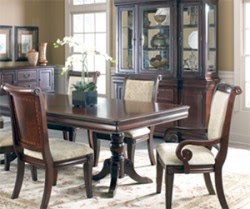
Offices, homes, hotels and virtually all places people spend their time require some form of furniture. Chairs, tables, desks, beds, wardrobe have gradually become a part of life.

Currently, the furniture industry is recording higher sales and observers think it is being driven by the craze for imported items and sheer ostentation.

Visit to workshops and showrooms in some parts of Accra revealed that though locally made furniture is much cheaper than imports of the same standard, most buyers both Ghanaian indigenes and foreigners resident in the country prefer the latter.

Local furniture dealers in the country, in recent times, are facing a major competition from importers despite the latter’s high prices.

Ghana has experienced the mushrooming of furniture marts, showrooms, centres and workshops in the recent past with most fittings imported from foreign countries.

Whereas furniture importers sell a sofa set for between GH¢700 and GH¢3000, the local version goes for as low as GH¢400 and GH¢1000. The main difference---quality and design.

A recent survey by the Association of Ghana Industries (AGI) has revealed that 78 percent of furniture on the Ghanaian market are imported, leaving only 32 percent to the local manufacturer.

The AGI study reports on how three sectors could be made efficient and productive. It noted that there were many problems facing the industry such as high domestic resource cost, high cost of doing business in Ghana as well as the period of registration and starting a business among others.

At the showroom of one importer in Accra, who did not want to be named, BUSINESS GUIDE learnt that local furniture makers were losing out “because they are not creative enough in designs”.

This foreign importer added that the locals were not emphasising quality and the finishing that was typical of the superior sheen of quality evident in imported furniture.

“We are conscious of environmental matters, the reason why our products are made from synthetic materials which are not only more durable than wood but also easier to work on,” he explained.

This dealer echoed the opinion of many players in the industry, saying that “the difference in quality is just too glaring with goods that pass certification, failing the test of time miserably.”

This, he says, has made many consumers insist on the best, in spite of the higher price tag on the imported units.

And there is another factor to explain this trend toward imported goods. Ghana, unlike the Asian exporters of furniture, lacks a well entrenched policy on environmental protection and the best the Government has done is to clamp down on logging, forcing practitioners in the timber sector to import the vital raw materials from countries like China, Dubai, India, South Korea, US, Togo and Malaysia among others.

The number of investors in the business has seen an upward trend but the more established players are calling for more stringent quality control with widespread concern that unscrupulous people pass low quality pieces as high-end furniture, eroding consumer-confidence in the process.

Prince Kwasi Diabo, General Manager of Agorwu Furnitures, is worried about the lax policy that is making the regulation of the sector difficult.

“There are mushroom workshops and furniture centres springing up on daily basis. It is like everyone is operating on his own, God for us all,” he says.

In an interview at the Dodowa Branch of the company that has become popular for its use of well seasoned tropical wood in making all kinds of furniture from the board room to the bedroom, Mr. Diabo pointed to some of the products on display and said “Look at the furnishing; quality is our benchmark but the importation of foreign furniture is affecting our share of the market and perception is swaying people as they think everything from a foreign market is of high quality.

“The common practice is where a dealer is also operating a workshop which is nowhere near the vicinity of the showroom and then pushes off products from his workshop alongside the imported ones, labelling all ‘imported’ ”.

This is the worst spectre haunting dealers with most advising that a customer should insist on quality and do their shopping diligently, observing keenly the kind of material in use and the finishing quality of the product.

However, Mr Paul Nyavor of Kpogas Standard Furniture Company Limited, where 40 percent of products on display in the showrooms are locally made while the rest are imported, says that products have to be labelled properly and the customer properly advised as there are customers for both the locally assembled and imported products.

Imported furniture has been in the market since the beginning of the country’s history with the advent of the Vono beds among other furniture equipment.

The dealers are however quick to add that contrary to popular belief, they do not target the jet set of the community but they serve a cross section of the market, including the low end group of society.

“We import some furniture and assemble some ourselves with different customer targets in mind,” said Mr. Nyavor, who agrees that the prices of imported products are more expensive than local ones.

The peculiar problems that his company faces are competition, power outage, and high cost of producing local furniture because of high cost of inputs (wood and abrasives).

With optimism, Mr. Nyavor foresees the future of the furniture manufacturing industry in Ghana to be more lucrative and “will continue to attract more competitors” as the domestic market is not yet saturated. “More houses, offices are being built and people change their furniture and will continue to change their furniture.

On the other hand, the influx of foreign furniture is not the only problem that the local manufacturers have to contend with; shortage of skilled labour, lack of raw material, obsolete machinery, financial constraint and the lenient government policy among others also form part of the headache of operators.

“The market itself is facing serious problems,” said Executive Director of the Association of Ghana Industries (AGI), Prof. Cletus Dordonu, Chief Executive Officer of Cledot Consult, said when he spoke on a TV magazine programme, “The Business Advocate” on Ghana Television to discuss the findings of a survey on the furniture industry.

Prof. Dordonu emphasizes that the patronage of locally manufactured furniture would come with a lot of benefits such as the creation of employment that will lead to the reduction of crime.

He admits that China, Dubai and India where importers now tend to look at, were not Ghana’s traditional trading partners “but with the development and expansion of their industry, Ghanaian traders look in that direction now”.

Mr. Nyavor thinks as the forests deplete, “companies will have to resort to bamboo and plastic material. Kpogas has a vast plantation to fall on in future as a strategic plan.”

For Agorwu Furnitures, by combining wood and metal, “we are not only reducing the use of wood but also giving our clients a variety to choose from”, said the Company’s General Manager.

Lack of education on why people should consume locally manufactured products is also a problem that needs to be looked at as quickly as possible. There is the need to create more awareness so that Ghanaians can consume what they produce.

Government is being blamed as in other countries subsidies are given to manufacturers who later export but in Ghana the opposite pertains and the local industry has to borrow from the banks at a high interest rate.

Government is therefore being called upon to reduce lending rate; but will the banks be able to do this in these times of global economic crisis?

Local raw material is expensive, which makes cost of production high and the supply of raw material is not regular and this makes manufacturers unable to meat customers demand.

“Sometimes, you have an order but you are not able to meet it because your suppliers have failed to deliver but foreign supply is very reliable,” said one player who combines local and imported furniture.

As the government is being called upon to come to the aid of the manufacturers of local furniture, the operators in the sector should also note that consumers intend to buy their products without compromising on the quality of service.

Tuesday, August 17, 2010

The Cry Of Mining Communities


Operators in the extractive industry, particularly mining companies, have always been criticised for contributing to the destruction of the environment and neglecting those affected by their operations.

Although products of mining form the foundation of human life as areas such as Agriculture, science and technology, manufacturing, construction, aviation, medicine, arts, communications, transportation and consumer goods depend on minerals and metals, the industry that produces the raw material for these is listed among the most destructive.

For the indigenes and farming communities mining affects, the activities of the extractive industry endanger their well-being.

Lucy Adutwumwaa, a resident of Asutifi district of Brong Ahafo, points to cracks in her building which she attributes to the activities such as blasting undertaken by the mining company in her community.

She claims she cannot drink from the river which is the only source of drinking water any more.

“I now have to buy expensive “pure water” (sachet water) and this, among other things, has made life difficult for me and my family.”

Many communities facing these challenges have organized against the companies by forming local, national, and international activist groups where they share information and work together to stop the harm that extractive industries cause.

In many cases, they have succeeded in stopping the mining or reducing its impact, though it takes time to achieve any results.

“The perception is that these extractive companies which are mostly transnational companies are in business to milk their host countries dry” Dr. Joyce Aryee, Chief Executive of the Ghana Chamber of Mines says, hinting that most people believe such companies are only interested in extracting the non-renewable resources, repatriating the huge profits and leaving the host country poor.

The minerals, metals, fuel, and timber that extractive industries seek are very profitable.

Ghana is endowed with minerals such as gold, diamond, manganese, bauxite as well as other industrial ones like salt, limestone and kaolin that are exploited on small-scale.

Gold accounts for the majority of mineral exports from Ghana yet residents of mining communities on countless occasions have petitioned the Ministry of Environment and Science, and the Ministry of Natural Resources to intervene “but to no avail,” observes Richard Adjei-Poku, Executive Director of Livelihood and Environment Ghana, an advocacy group.
For Nana Philip Prempeh of Kenyasi, “the mining companies are simply cheats.”

But is it true that mining companies only destroy the environment? PriceWaterhouseCoopers says mining companies are contributing “extensively” to national development.

However, the audit firm claims these contributions are not usually recognized.

To ascertain the value of the contributions of mining companies in Ghana, PriceWaterhouseCoopers conducted a survey: “Total Tax Contribution- A study of the economic contribution mining companies make to public finances.”

It recognized mining companies as important elements in the creation of wealth and development of countries in which they operate.

George Kwatia, Tax Partner at the PriceWaterhouseCoopers, affirms that the contribution of the mining sector is usually not recognized.

The companies that were covered under the survey reported a total turnover of $62.9 billion of which $10.1 billion went to various governments while $6 billion went to employees as wages and salaries.

Corporate income tax formed 40 per cent of all taxes and contributions in addition to other non-income taxes comprising royalties, VAT and infrastructure funding.

An amount equivalent to 15.3 per cent out of the total turnover of mining companies went to governments.

“Mining companies have over the years consistently maintained the position as the highest gross foreign exchange earner as well as providing jobs in the country,” says Dr. Aryee.

“It is good to have such surveys which indicate that we are not being ripped off,” she tells the surveyors.

Mineral royalties increased from GH¢1.9 million in 1990 to about GH¢90 million in 2009 and mineral royalties accounted for about 94 per cent of state royalties during the same period.

The mining industry in 2009 also paid an amount of GH¢125 million as corporate tax while GH¢1.7 billion was collected by the Internal Revenue Service (IRS) from mining companies.

To Dr. Aryee, fiscal imposts alone do not reflect the total value to the mining sector of the country as there are other indirect contributions such as foreign direct investment and secondary industries that also offer employment, and pay statutory taxes that positively contribute to national development.

Since the introduction of the Minerals and Mining Law, PNDC Law 153 of 1986, Dr. Aryee hints the country’s mining industry has recorded phenomenal growth as it continues to attract huge investments.

Records at the Minerals Commission indicate that Foreign Direct Investment (FDI) in the mining sector increased from $6 million in 1983 to $427 million in 2007.

The Mining industry in Ghana has seen a phenomenal growth especially after the Government's Economic Recovery Programme in 1983, due to the large investment inflows into the sector.

The friendly climate and the continuing high gold price in recent times, according to experts, guarantees greater profits for operators in the industry.

Yet to the mining companies, their full profitability will be realized if key challenges facing the industry such as encroachment of ‘galamsey’ miners on mining concessions, high import taxes and high interest rates are addressed.

Players in the industry who want to remain unnamed claim they continue to strive to add value to the communities in which they operate.

They claim they are at the forefront of the corporate social responsibility agenda in their host communities: Apart from their statutory contributions, they voluntarily provide schools, libraries, hospitals, electricity, potable water, roads, housing, sanitation facilities and alternative livelihood projects.

For the Chief Executive of the Chamber of Mines, Corporate Social Responsibility “is not an option but a necessity that enables the mining company to plough back some of its earnings to raise the quality of life of the communities.”

Social licence, with which players in the industry operate, rests in the hands of the host communities, and that to ensure a continuous renewal, there is the need to honour Corporate Social Responsibility roles to residents of mining communities as well as Ghanaians in general.

The Chamber therefore sees mining as a catalyst for national development since it engenders positive multipliers whose effects ripple through the whole economy.

Dr. Aryee suggests government and the mining industry should craft deliberate policies, plans and strategies to ensure that the potential for mining to contribute to national development.

“It is our expectation that the Government will also increase the quantum of mineral royalties that goes to the mining communities.”

Through the fiscal receipts the state derives from the sector as well as the developmental imperatives which accrue to the country, anyone can say mining has contributed enormously to the growth of the Ghanaian economy, but residents of mining communities who bear the brunt of the negative implications of the activities of the companies hold a different view.

Dr. Darcy White, Tax Partner at the PriceWaterhouseCoopers has therefore recommended that mining companies should consider if there could be business benefits from being more transparent in communicating their tax affairs to their stakeholders.